







- Coupled Wrinkling and Bending in Strain-Mismatched Tri-Layer Structures
Hyunsu Kwak*# , Junsik Kim*# , Anna Lee*†
* Department of Mechanical Engineering, POSTECH
This article is an open access article distributed under the terms of the Creative Commons Attribution Non-Commercial License (http://creativecommons.org/licenses/by-nc/4.0) which permits unrestricted non-commercial use, distribution, and reproduction in any medium, provided the original work is properly cited.
Wrinkled structures have been widely used to accommodate large deformation through reversible geometric transformations. In this study, we investigate coupled wrinkling and bending in a strain-mismatched tri-layer structure composed of a thin film sandwiched between two pre-strained elastomeric substrates. Upon release of the pre-strain, mismatch-induced compressive stress leads to simultaneous global bending of the structure and localized wrinkling of the film. The bending curvature is governed by the thickness ratio of the substrates, while the onset of wrinkling is determined by the normalized film stiffness. A theoretical model based on energy minimization describes the bending curvature, and a linear buckling analysis provides the critical wrinkling condition. Experimental observations and finite element simulations show good agreement with the theoretical predictions. The results provide a mechanical framework for understanding and designing coupled bending-wrinkling behavior in multilayer soft structures.
Keywords: Wrinkling, Buckling instability, Multilayer structures, Bending curvature
Wavy electrode structures have garnered significant attention in the field of stretchable electronics due to their ability to undergo reversible unfolding and folding. By effectively mitigating residual strain to ensure structural integrity under extreme deformation, these wavy geometries have been widely adopted across stretchable electronics [1,2], surface engineering [3,4], wearable sensors [5,6], and smart displays [7,8]. Such wavy structures are primarily designed as either vertical serpentine geometries or wrinkling-type architectures. The former relies on pre-designed curvilinear patterns produced by screen printing [9,10] or 3D printing [11]; in contrast, the latter is mechanically generated by buckling within thin film/substrate systems through a pre-stretch and release process [12,13].
Recently, conformal stretchable electronics designed to wrap non-planar surfaces, including spherical, cylindrical, and other curved geometries, have attracted significant attention [14–16]. For these applications, electrode layers must satisfy stringent mechanical requirements, including high stretchability, enhanced bendability, and cyclic repeatability, to ensure long-term stability for elastic deformations. To address the requirements, conventional strategies typically rely on precise neutral-axis engineering, which is achieved through multi-layered composite structures incorporating encapsulation or adhesive interlayers [17,18]. However, these multilayer configurations increase structural complexity, thereby complicating the packaging process and inevitably increasing the overall device thickness, which makes it challenging to simultaneously achieve structural optimization and high performance under repeated bending and stretchability.
Despite the growing relevance of such multilayer systems, the coupled mechanics of wrinkling and global bending in trilayer or multilayer structures remains largely unexplored. While wrinkling in simple bilayer systems has been extensively studied—from critical buckling conditions [19,20] to post-buckling behavior and substrate pre-stretch effects [21,22]—these models predominantly assume semi-infinite substrate geometries where global bending is inherently absent. As substrates have become thinner in pursuit of lightweight designs, bending-induced curvature has grown in significance, driving the adoption of trilayer configurations with additional encapsulation or upper substrate layers [23,24]. Although wrinkling in such trilayer structures has been investigated through parametric theoretical and numerical analyses [25-29], the majority assume flat or semi-infinite conditions, leaving the effect of global bending under finite substrate thickness largely unaddressed. While a few bilayer studies have considered finite-thickness effects and the interplay between wrinkling and global bending [30-32], this coupled behavior in trilayer or multilayer structures remains insufficiently explored. The present study addresses this gap by examining the coupled evolution of global bending and local wrinkling in strain-mismatched tri-layer structures with finite substrate thickness.
In this study, we consider a strain-mismatched tri-layer structure in which a thin film is sandwiched between two pre-strained elastomeric substrates. Upon release of the pre-strain, the mismatch between the layers gives rise to coupled global bending and localized wrinkling. We focus on how the substrate thickness ratio and the normalized film stiffness govern the resulting deformation modes. To this end, a theoretical framework based on energy minimization is formulated to describe the global bending, and a linear buckling analysis is employed to characterize the onset of wrinkling. In addition, finite element simulations and experiments are conducted to examine the deformation behavior under varying geometric and material parameters.
2.1 Wrinkling and global bending in a tri-layer composite
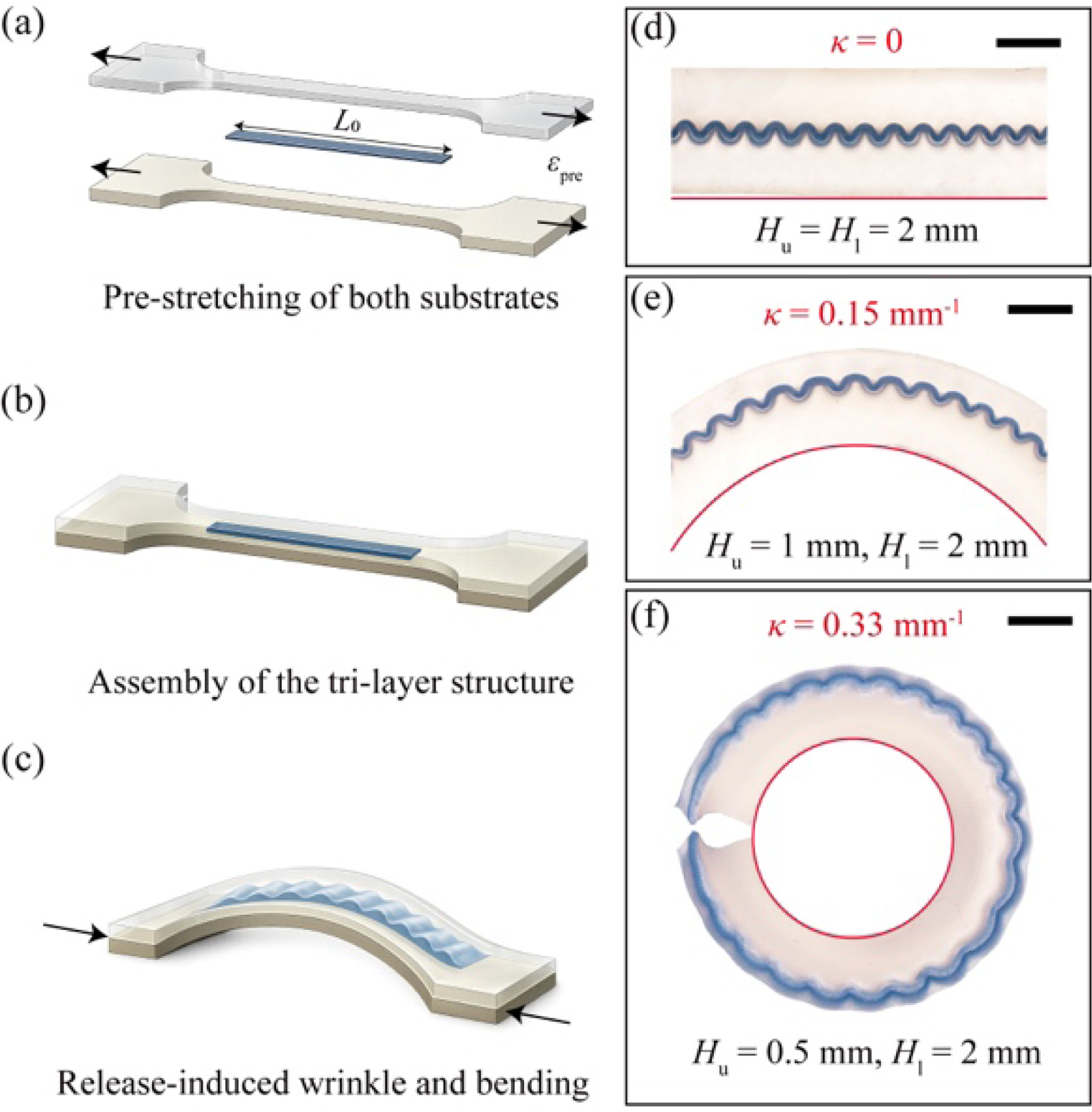
Fig. 1 schematically illustrates the fabrication process of the tri-layer composite exhibiting bending and wrinkling. In Fig. 1(a), the upper and lower substrates are pre-stretched by an applied pre-strain, εpre. Both substrates are fabricated from Ecoflex 00-30 (Smooth-On, Inc.), a two-part silicone elastomer consisting of Part A (base) and Part B (catalyst). The two parts were mixed in a 1:1 ratio by weight, poured into a mold of the desired geometry (dog-bone shape), and cured at room temperature for approximately 4 hours.
The film layer with an initial length of (L0 = 50 mm) is then formed between the upper and lower substrates by coating it onto the pre-stretched lower substrate. Specifically, a prepolymer solution of vinylpolysiloxane (VPS-32, Zhermack) was prepared at a 1:1 base-to-catalyst ratio by weight. Prior to deposition, a masking tape was applied to the pre-stretched substrate to confine the coating area to the initial gauge length L₀, ensuring that the film was formed only within the intended region. The prepolymer solution was then deposited onto the exposed area and spin-coated at 600 rpm for 60 s, yielding a uniform film thickness of approximately 180 μm. The masking tape was then carefully removed, and the film was subsequently allowed to partially cure for ~15 min at room temperature.
The elastic moduli of VPS-32 and Ecoflex-0030 were determined from the uniaxial tensile tests described in Section 2.2, yielding Ef ≈ 0.864 MPa and Es ≈ 0.148 MPa, respectively. The Poisson's ratio was assumed to be ν = 0.49 for all layers.
In Fig. 1(b), after the prepolymer solution had partially cured, the upper substrate was attached. At this partially cured stage, the film layer exhibited sufficient adhesion to achieve perfect bonding with both the lower and upper substrates. Since VPS-32 and Ecoflex-30 are both siloxane-based elastomers, favorable interfacial compatibility during curing contributed to strong bonding between the layers. No additional external pressure was applied during the bonding process in order to avoid unintended changes in the film thickness. The upper substrate was placed on the partially cured VPS-32 layer and bonded during the subsequent curing process. Moreover, no visible interfacial delamination was observed during the experiments, even under the largest pre-strain. This supports the perfect interfacial bonding throughout the deformation range.
In Fig. 1(c), after ~30 min, the VPS-32 film was fully cured. Subsequently, the pre-strain applied to both substrates was simultaneously released, generating compressive stress during relaxation. This compressive stress induced wrinkling of the film layer, together with global bending of the entire structure.
In Figs. 1(d to f), optical images of the tri-layer composite exhibiting global bending coupled with wrinkling are presented. The thickness of the upper substrate (Hu) varied as 2, 1, and 0.5 mm, while the thickness of the lower substrate (Hl) was fixed at 2 mm. In all cases, the applied pre-strain was maintained at εpre ≈ 1.1 (110%). In Fig. 1(d), under the symmetric condition where the upper and lower substrate thicknesses are identical, the bending curvature (κ) is zero because the neutral axis is located at the center of the structure and coincides with the film layer. In Figs. 1(e) and 1(f), under asymmetric conditions (Hl > Hu), κ gradually increased as the thickness of the upper substrate decreased. Furthermore, the film layer exhibited wrinkling with smaller amplitudes and longer wavelengths as the upper substrate became thinner.
2.2 Constitutive models
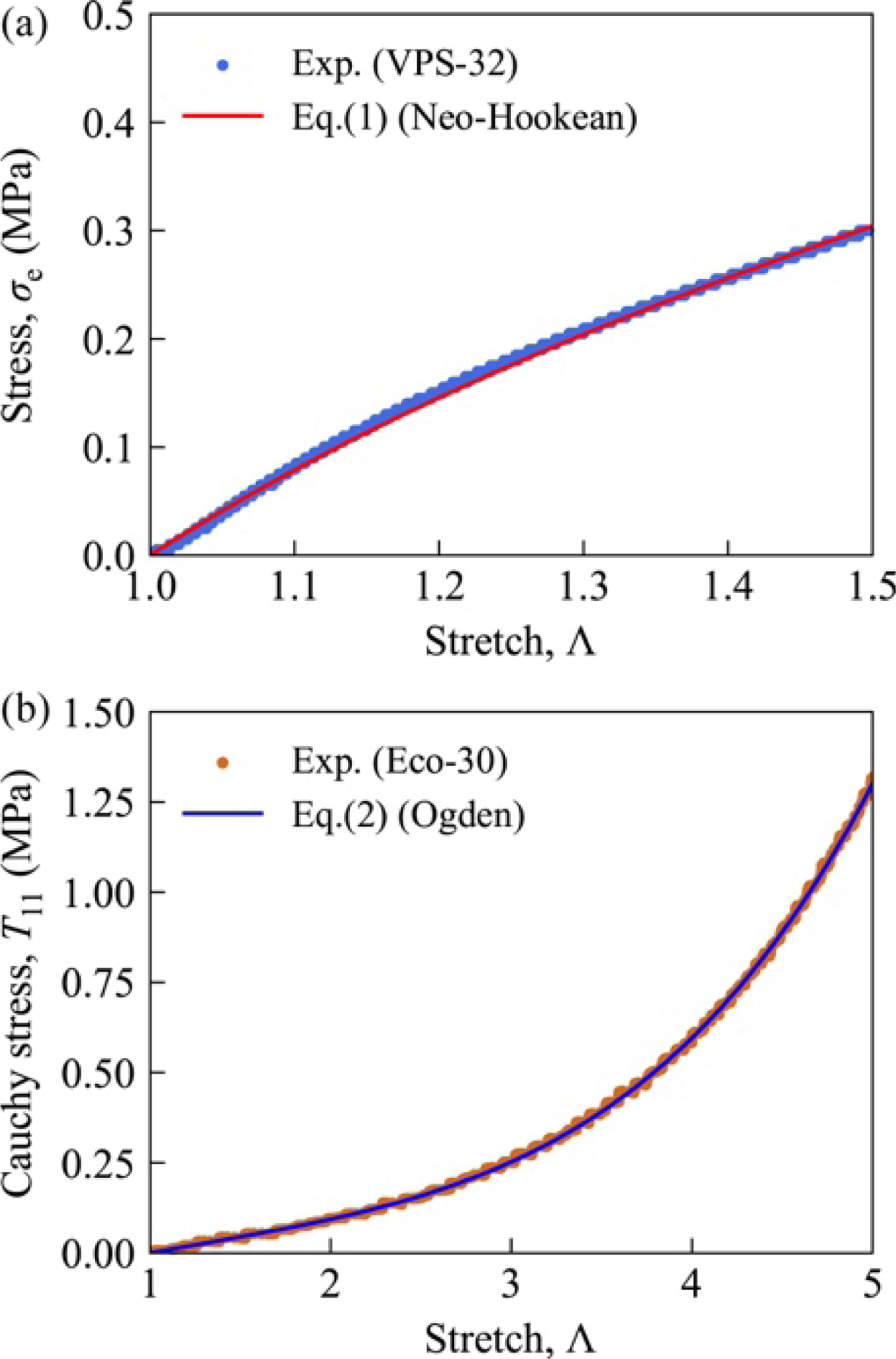
To analyze the wrinkling and bending behavior, constitutive models were employed for each layer. The film layer (VPS-32) was modeled using a Neo-Hookean constitutive law, whereas the substrate (Ecoflex 00-30) was described by an Ogden model. The Neo-Hookean model was selected for VPS-32 because the film was deposited onto the substrates while they were held in the pre-stretched state and its measured stress-strain response was adequately captured by the Neo-Hookean model. In contrast, the Ogden model was adopted for Ecoflex-0030 to represent its highly nonlinear behavior under large pre-strains. Under uniaxial tension and the incompressibility assumption, the Neo-Hookean model is given by

where C͞͞1 is the half shear modulus as a material constant, σe is the engineering stress, and Λ is the stretch ratio (1 + ε). The Ogden model can be written as

where T11 is the Cauchy stress as T11 = σe·Λ. For the tensile test, specimens were prepared in accordance with ASTM D412 Type C standard. Uniaxial tensile tests were performed using a universal testing machine (Instron 5943, Instron Corp., USA). The strain rate was set to 500 mm/min, which is commonly adopted for the mechanical characterization of soft materials.
Figs. 2(a) and 2(b) show the constitutive model fitting results for VPS-32 and Ecoflex-0030, respectively. According to Eq. (1), C͞͞1 of VPS-32 was 0.144 MPa, and the Ogden coefficients of Ecoflex-0030 are written in the caption of the figure. The Ogden model parameters (a₁,₂,₃ and μ₁,₂,₃) listed in the caption of Fig. 2 were determined by least-squares fitting of the Ogden model (Eq. 2) to the uniaxial tensile test data obtained in this study.
Since the present study focuses on quasi-static equilibrium deformation, the materials were modeled as hyperelastic solids and viscoelastic effects were not considered.
|
Fig. 1 Experimental process and global bending coupled with wrinkling. (a–c) Pre-stretching, assembly, and release processes are used to induce buckling for wrinkling and curvature in the tri-layer composite. (d–f) Optical images of the experimental results showing wrinkling behavior with varying bending curvature controlled by the uppersubstrate thickness |
|
Fig. 2 Constitutive fitting results of the hyperelastic materials. (a) Neo-Hookean fitting model of the film layer as VPS-32. (b) Experimental Cauchy stress-stretch response of Ecoflex-0030 fitted with the Ogden model in Eq. (2), using the fitted parameters a1 = -0.2957, a2 = 1.011, a3 = 4.323, μ1 = -0.3346 MPa, μ2 = 0.08142 MPa, and μ3 = 0.0009939 MPa |
3.1 Global bending
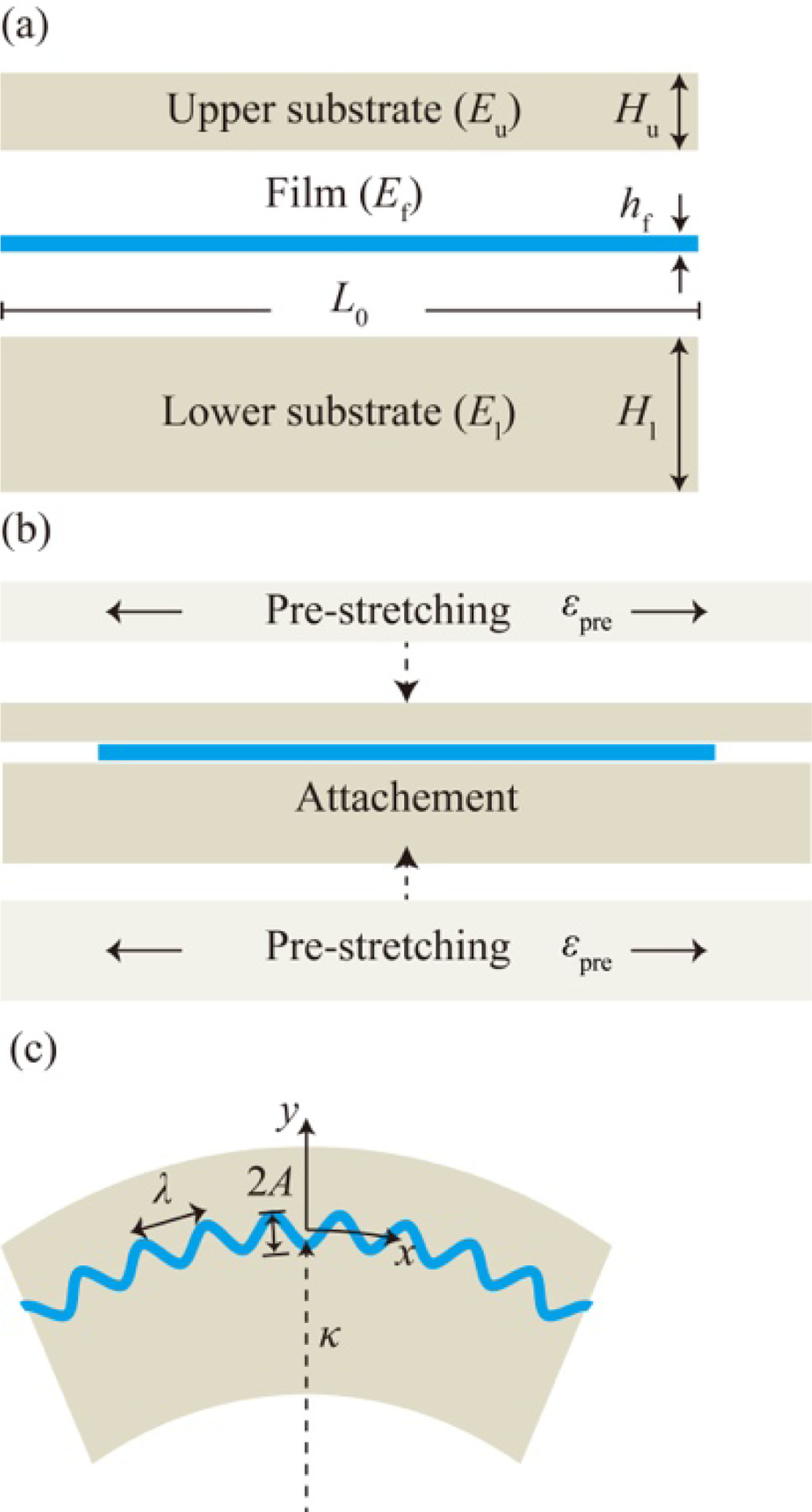
To elucidate the coupled mechanics of wrinkling and global bending in the proposed tri-layer structure, theoretical models were developed to describe the elastic deformation under substrate pre-strain release. In Fig. 3(a), the film layer, upper and lower substrates have elastic moduli, thicknesses, and Poisson’s ratios of (Ef, hf, vf), (Eu, Hu, vu), and (El, Hl, vl), respectively. The materials are assumed to be nearly incompressible.
Accordingly, the Poisson’s ratios are taken as 0.49 to ensure numerical stability while approximating the incompressible limit. In Fig. 3(b), the upper and lower substrates were pre-stretched by the same applied pre-strain, εpre, and the film layer was sandwiched between them. In Fig. 3(c), the compressive stress generated by the release of the pre-stretched substrates induces buckling deformation, accompanied by wrinkling and global bending of the structure. Here, the wrinkling profile is characterized by the amplitude (A), wavelength (λ), and the bending curvature is κ.
The global bending curvature is determined by minimizing the bending energy stored in the film and the substrates after release of the pre-strain. The total bending energy consists of contributions from the film (Ub, film) and from the upper and lower substrates (Ub, subs). The bending energy stored in the film is expressed as

and

where εf is the membrane strain in the film, εs is the strain in each substrate (εs=εpre+εf+εy), and E͞͞ is the plane-strain modulus given by E͞͞=E/(1-v2) where v is the Poisson’s ratio. Here, the major dimensionless parameters are

where α, β, and γ denote the modulus ratio between the upper and lower substrates, the thickness ratio of the two substrates, and the normalized film stiffness relative to the lower substrate, respectively. Minimizing the total bending energy (Ub = Ub,film + Ub,subs) with respect to εf and κ (∂Ub/∂εf=0,∂Ub/∂K=0) yields

and

In Eqs. (6) and (7), the functions D0(α, β) and D(α, β, γ) are defined as
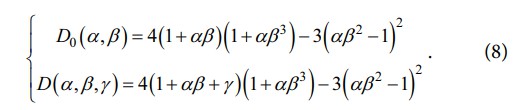
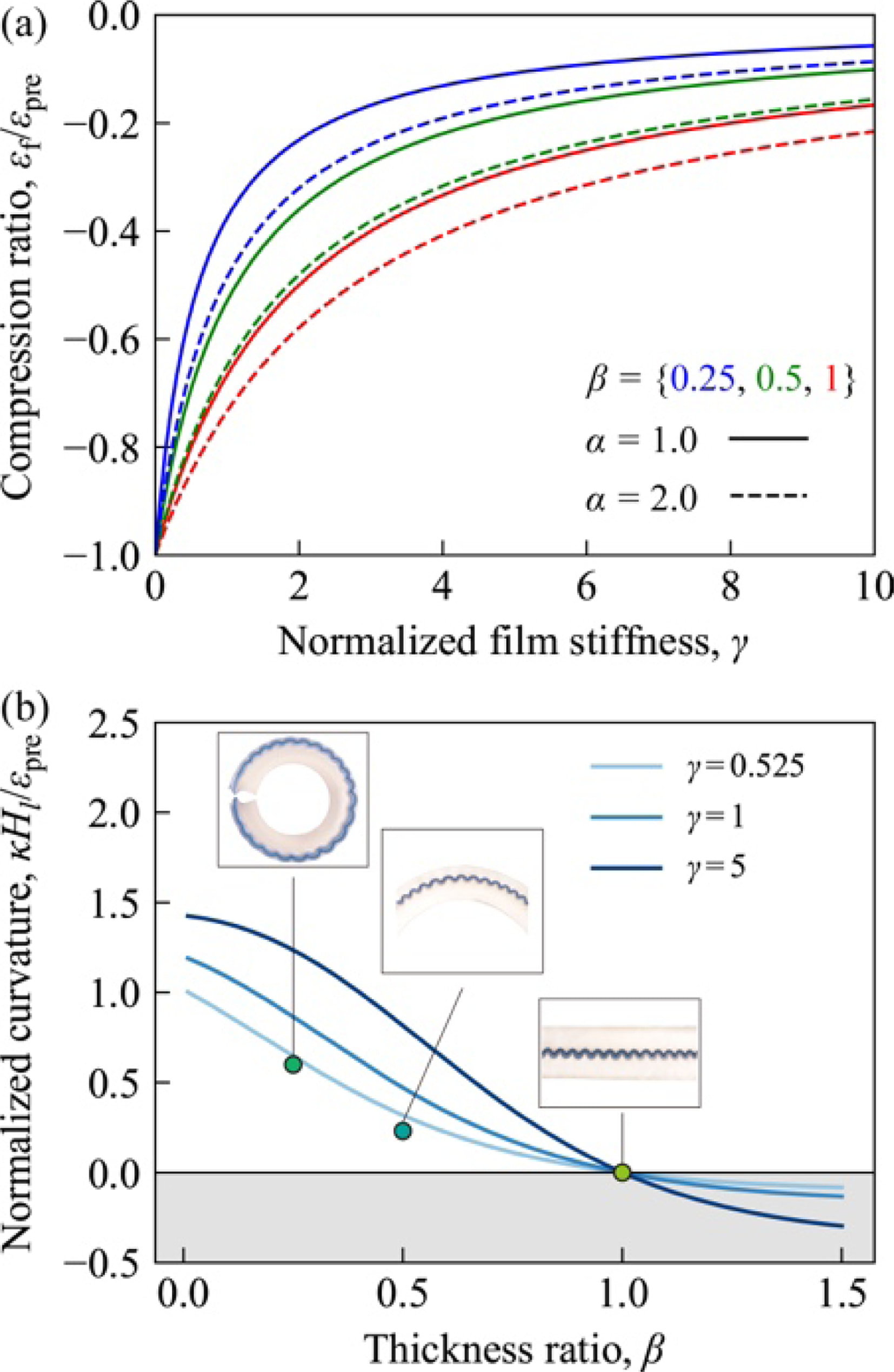
Eqs. (6) and (7) indicate the compression ratio (εf/εpre) of the membrane strain to the applied pre-strain and the normalized curvature, respectively.
Fig. 4(a) shows how the membrane strain transferred from the applied εpre varies with α, β, and γ. As γ decreases, the compression ratio (εf/εpre) approaches -1, indicating efficient transfer of the applied pre-strain to the film. In contrast, as γ increases, εf/εpre approaches 0, implying a smaller compressive strain in the film. Likewise, as β decreases, meaning that the upper substrate becomes thinner, the membrane strain in the film also decreases. If the membrane strain is too small, the criterion for local buckling is not satisfied, and the structure undergoes pure bending without wrinkle formation.
Fig. 4(b) compares the normalized curvature obtained from the theoretical model with the experimental results. The VPS-32 film layer was assumed to Ef of 864 kPa, while the elastic moduli of Ecoflex-0030 for the upper and lower substrates (Eu = El = 148 kPa) were obtained from the initial slope of the Ogden model. Given that Hl ≈ 2 mm, and hf ≈ 180 μm, γ for our case is approximated to 0.525.
In Fig. 4(b), the experimental observations (γ = 0.525) agree well with the theoretical predictions as a function of β. As γ increases, the global bending curvature increases (in Fig. 4(b)), while the membrane strain transferred to the film decreases (in Fig. 4(a)). This indicates that less of the deformation energy induced by pre-stretching is stored as membrane energy, while a larger portion is accommodated by bending energy.
From Eq. (7), the zero-curvature condition (κ = 0) is obtained when it is satisfied with αβ2 = 1, which leads to

Eq. (9) represents the material condition required to eliminate the global bending curvature of the tri-layer composite. This relation indicates that the second-order stiffness of the upper and lower substrate layers must be balanced.
3.2 Linear buckling model of wrinkling
Linear buckling theory is adopted because the analysis focuses on the critical onset of wrinkling, i.e., the bifurcation point at which the initially flat equilibrium configuration first becomes unstable. At this critical point, the wrinkling amplitude is infinitesimally small, and thus a linearized perturbation approach is analytically tractable for predicting the onset condition.
The wrinkling displacement of the film was approximated by a sinusoidal profile, w = Acos(kx), where x is the coordinate along the curvature line and k is the wavenumber defined as k = 2π/(λ(1 +εpre)). According to von Karman plate theory [33], the strain energy stored in the film layer consists of both membrane energy and bending energy, and is expressed as

The substrate strain energy is obtained from the normal stress acting at the film/substrate interfaces, namely, the interface between the film and the upper substrate and that between the film and the lower substrate. For thin substrates, the corresponding elastic energy contributions [34] are written as
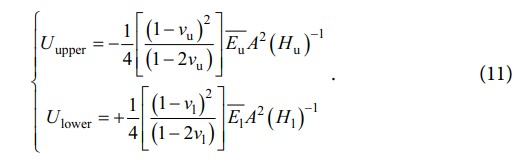
The equilibrium state of the wrinkling deformation is then determined by minimizing the total energy (Utot = Ufilm + Uupper + Ulower) with respect to A and k. The normalized wrinkle wavelength and amplitude can be expressed as
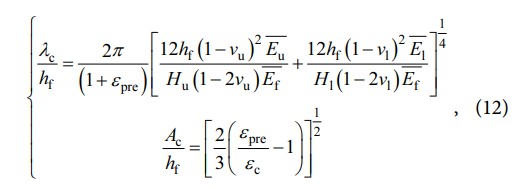
where the critical buckling strain εc is given by

In Eq. (12), the critical normalized wavelength and amplitude are expressed for a thin-substrate system with asymmetric substrate thicknesses. Eq. (13) gives the critical buckling strain to obtain the local wrinkles in the film-layer, and it is simplified (vu = vl = vs) as

Simultaneous bending and wrinkling can occur only when the bending-induced compressive strain in Eq. (6) exceeds the critical buckling strain in Eq. (14). This condition is expressed as
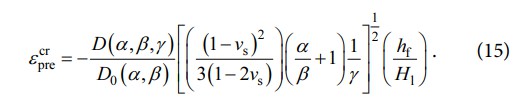
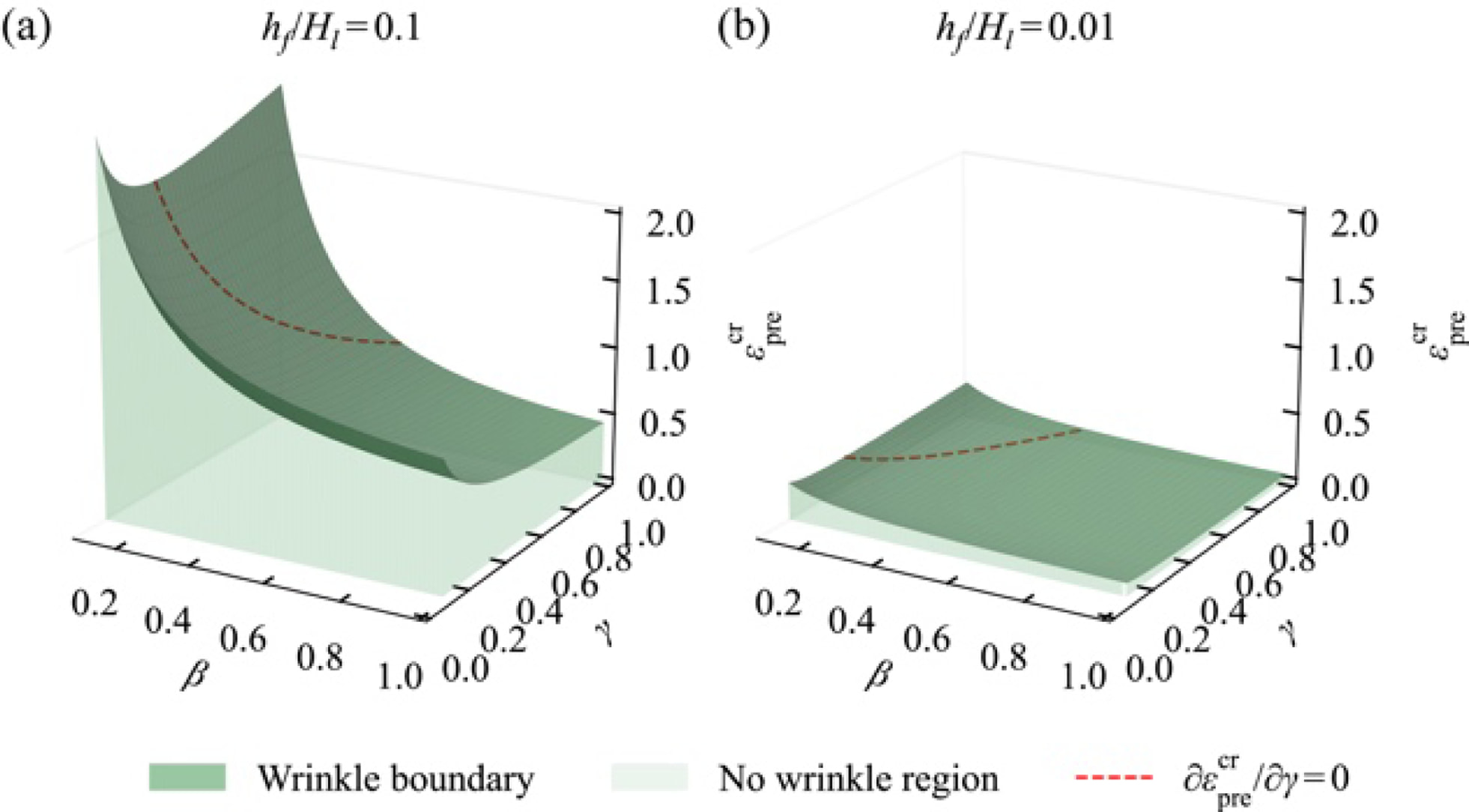
Fig. 5 shows Eq. (15) with respect to β and γ for α = 1, considering two representative thickness ratios, hf/Hl = 0.1 (thin-substrate) and 0.01 (thick-substrate). For hf/Hl = 0.01, εcrpre is significantly low for the entire β-γ domain, other than for hf/Hl = 0.1. Furthermore, the lower β (thinner upper substrate thickness) monotonically needs a higher εcrpre value to obtain the wrinkling. In contrast, for γ, the local minimum of εcrpre is determined by derivatives Eq. (15) with respect to γ (red-dashed line).
|
Fig. 3 Schematic diagram of the buckling-induced global bending and wrinkling. (a) Initial configuration of the tri-layer structure consisting of the upper substrate, film layer, and lower substrate. (b) Pre-stretching of the upper and lower substrates to the same applied strain, followed by assembly with the film layer. (c) Release-induced buckling deformation, resulting in simultaneous wrinkling, is characterized by amplitude and wavelength (A, λ) and global bending curvature (κ) |
|
Fig. 4 Compression ratio and normalized curvature in the trilayer composite. (a) Variation of the normalized membrane compression with γ for different combinations of α and β. (b) Normalized curvature as a function of β for γ = 0.525 (our exp.). The inset images show representative deformation modes at different β, and the shaded region indicates negative curvature (κ < 0) |
|
Fig. 5 Critical pre-strain for wrinkles as a function of β and γ for α = 1. (a) hf /Hl = 0.1 and (b) hf /Hl = 0.01. The dark green surface denotes the wrinkle boundary, while the light green region indicates the no-wrinkle regime |
Numerical simulations were performed to reproduce the experimental observations. Finite element analyses were performed under plane-strain conditions using the commercial software ABAQUS. The tri-layer composite was discretized using four-node hybrid plane-strain elements with reduced integration (CPE4RH). In the model, the initial thicknesses of the upper and lower substrates were set to 1 mm and 2 mm, respectively, and the film thickness was taken as 0.18 mm. The total length of the tri-layer composite was set to 50 mm. The constitutive model of the substrate was described by the Ogden model, whereas that of the film was described by the Neo-Hookean model (see Fig. 2). A mesh convergence study confirmed that an element size of 0.04 mm along the longitudinal and thickness direction was sufficient to obtain sufficiently converged results. The simulations were performed using a nonlinear Static, General step under fully free boundary conditions. To simulate the release of pre-stretch in the experiments, residual stress fields were assigned to the substrates as predefined fields corresponding to the tensile pre-strain applied during stretching. This procedure effectively reproduced the compressive stress state developed in the film after release of the pre-stretch. A small geometric imperfection was further introduced in the form of a sinusoidal perturbation with an amplitude equal to 1% of the film thickness and a wavelength determined from the theoretical prediction.
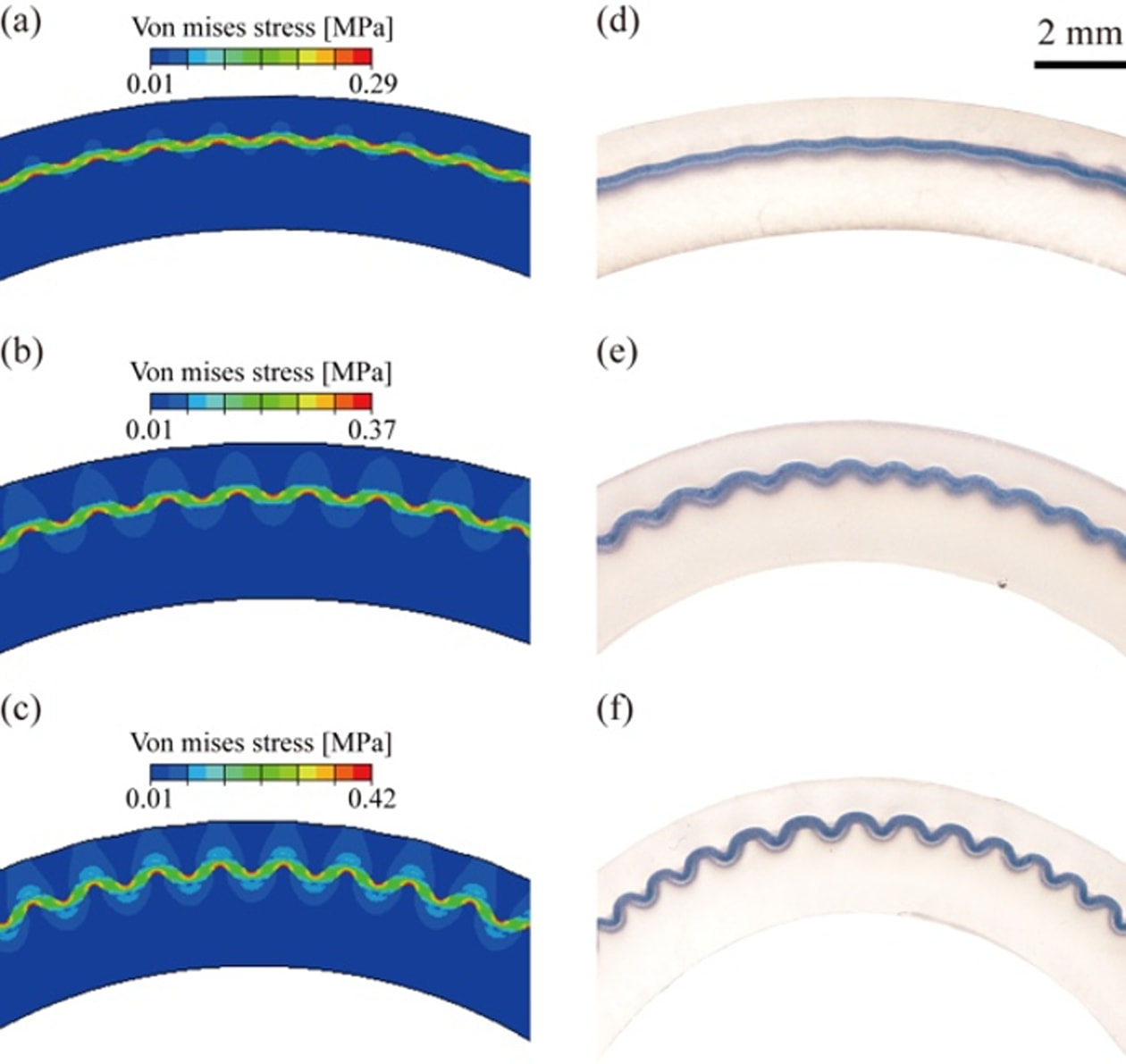
Fig. 6 shows the evolution of the wrinkling under global bending, together with the corresponding FEM and experimental results. FEM simulations were conducted at εpre of 0.6, 0.8, and 1.1, with all other parameters held constant. In Figs. 6(a) and (d), at the early stage of εpre, the onset of wrinkling is observed, characterized by a shallow amplitude and a long wavelength. As εpre increases, the wrinkling becomes more pronounced, exhibiting a larger amplitude A and a shorter wavelength λ.
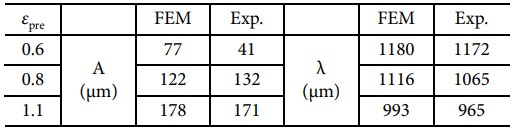
Table 1 summarizes the quantitative comparison of A and λ between the FEM and the experimental measurements. The wavelength λ was measured as the average peak-to-peak distance over a minimum of five wrinkle periods, and the amplitude was defined as half the peak-to-valley vertical displacement. In the FEM results, λ and A were extracted from the out-of-plane displacement profile of the film layer using the same definitions.
At εpre = 0.6, the FEM-predicted amplitude (77 μm) overestimates the experimental value (41 μm). This discrepancy is attributed to the sinusoidal geometric imperfection (1% of film thickness) prescribed in the FEM to trigger wrinkling, which artificially amplifies the wrinkling amplitude near the critical buckling onset. At higher pre-strains (εpre = 0.8 and 1.1), where wrinkling is well-developed, the relative influence of the initial imperfection becomes less significant, and the FEM results show good agreement with the experiments.
Here, the decrease in λ with increasing εpre can be attributed to the combined influence of two competing effects: the strain-driven compression, which directly promotes wrinkling and reduces the wavelength, and the curvature-induced geometric confinement associated with global bending. Under the present experimental condition (β = 0.5) the strain-driven effect appears to dominate, resulting in a net decrease in wavelength. However, as β decreases further and the bending curvature increases, the influence of geometric confinement may become more significant.
|
Fig. 6 FEM and experimental results of wrinkle morphology in the strain-mismatched tri-layer composite. (a) εpre = 0.6, (b) εpre = 0.8 and (c) εpre = 1.1 for the FEM simulations. (d) εpre = 0.6, (e) εpre = 0.8 and (f) εpre = 1.1 for the corresponding experimental observations |
|
Table 1 Comparison of A and λ between FEM and experiments under different pre-strains |
In this study, we investigated coupled bending and wrinkling in a strain-mismatched tri-layer structure composed of pre-strained elastomeric substrates and a thin intermediate film. A theoretical framework combining energy minimization for global bending and linear buckling analysis for wrinkling was developed, and the predictions were validated through experiments and FEM simulations. The results show that the global bending curvature is governed by the substrate thickness ratio and the applied pre-strain, whereas the onset and wavelength of wrinkling are determined by the normalized film stiffness of the intermediate film. In particular, the strain mismatch is not entirely transferred to the film but is partially relaxed through global bending, leading to a coupled response in which bending and wrinkling compete to accommodate the imposed mismatch.
This coupling provides a useful mechanical perspective for designing multilayer soft structures, where the distribution of strain between global deformation and local instability can be tuned through geometric and material parameters. Such control may be utilized in applications requiring programmed surface morphologies or controlled curvature, for example in soft interfaces, adaptive surfaces, and mechanically tunable layered systems.
- 1. Jia, Z., Peng, C., Lou, J., and Li, T., “A map of competing buckling-driven failure modes of substrate-supported thin brittle films,” Thin Solid Films, Vol. 520, No. 21, 2012, pp. 6576-6580.
-

- 2. Zhao, Z., Fu, H., Tang, R., Zhang, B., Chen, Y., and Jiang, J., “Failure mechanisms in flexible electronics,” International Journal of Smart and Nano Materials, Vol. 14, No. 4, 2023, pp. 510-565.
-
- 3. Yang, S., Khare, K., and Lin, P.C., “Harnessing surface wrinkle patterns in soft matter,” Advanced Functional Materials, Vol. 20, No. 16, 2010, pp. 2550-2564.
-
- 4. Liu, N., Lu, Y. Li, Z., Zhao, H., Yu, Q., Huang, Y., Yang, J., and Huang, L., “Smart wrinkled interfaces: patterning, morphing, and coding of polymer surfaces by dynamic anisotropic wrinkling,” Langmuir, Vol. 40, No. 36, 2024, pp. 18837-18856.
-
- 5. Lee, J., Park, H., Kim, S., Liu, C., Li, Z., and Sim, K., “Irreproducible SEBS wrinkling based on spin evaporation enabling identifiable artificial finger pad electronics,” Nature Communications, Vol. 16, No. 1, 2025, 2225.
-
- 6. Cai, Y.W., Zhang, X.N., Wang, G.G., Li, G.Z., Zhao, D.Q., Sun, N., Li, F., Zhang, H.Y., Han, J.C., and Yang, Y., “A flexible ultra-sensitive triboelectric tactile sensor of wrinkled PDMS/MXene composite films for E-skin,” Nano Energy, Vol. 81, 2021, 105663.
-
- 7. Wu, K., Sun, Y., Yuan, H., Zhang, J., Liu, G., and Sun, J., “Harnessing dynamic wrinkling surfaces for smart displays,” Nano Letters, Vol. 20, No. 6, 2020, pp. 4129-4135.
-
- 8. Choi, S., Jo, W., Jeon, Y., Kwon, S., Kwon, J.H., Son, Y.H., Kim, J., Park, J.H., Kim, H., Lee, H.S., Nam, M., Jeong, E.G., Shin, J.B., Kim, T.S., and Choi, K.C., “Multi-directionally wrinkle-able textile OLEDs for clothing-type displays,” npj Flexible Electronics, Vol. 4, No. 1, 2020, 33.
-
- 9. Noh, Y., Lee, G., Lee, H., and Lee, D., “Printable stretchable serpentine electrodes incorporating support patterns for stretchable elecronics,” ACS Applied Materials & Interfaces, Vol. 17, No. 45, 2025, pp. 62733-62742.
-
- 10. Kim, J., Choi, H.W., Kim, B., Kim, E., and Kim, J., “Flexible electrode on e-textile based on screen-printed silver ink carbon nanotube,” The International Journal of Advanced Manufacturing Technology, Vol. 134, No. 1, 2024, pp. 127-137.
-
- 11. Qian, J., Chen, Q., Hong, M., Xie, W., Jing, S., Bao, Y., Chen, G., Pang, Z., Hu, L., and Li, T., “Toward stretchable batteries: 3D-printed deformable electrodes and separator enabled by nanocellulose,” Materials Today, Vol. 54, 2022, pp. 18-26.
-
- 12. Budday, S., Andres, S., Walter, B., Steinmann., P., and Kuhl, E., “Wrinkling instabilities in soft bilayered systems,” Philosophical Transactions of the Royal Society A: Mathematical, Physical and Engineering Sciences, Vol. 375, No. 2093, 2017, 20160163.
-
- 13. Auguste, A., Jin, L., Suo, Z., and Hayward, R.C., “The role of substrate pre-stretch in post-wrinkling bifurcations,” Soft Matter, Vol. 10, No. 34, 2014, pp. 6520-6529.
-
- 14. Jiao, R., Wang, R., Wang, Y., Cheung, Y.K., Chen, X., Wang, X., Deng, Y., and Yu, H., “Vertical serpentine interconnect-enabled stretchable and curved electronics,” Microsystems & Nanoengineering, Vol. 9, 2023, 149.
-
- 15. Xu, S., Zhang, Y., Cho, J., Lee, J., Huang, X., Jia, L., Fan, J.A., Su, Y., Su, J., Zhang, H., Cheng, H., Lu, B., Yu, C., Chuang, C., Kim, T., Song, T., Shigeta, K., Kang, S., Dagdeviren, C., Petrov, I., Braun, P.V., Huang, Y., Paik, U., and Rogers, J.A., “Stretchable batteries with self-similar serpentine interconnects and integrated wireless recharging systems,” Nature Communications, Vol. 4, 2013, 1543.
-
- 16. Kim, D. H., Lu, N., Ghaffari, R., Kim, Y.S., Lee, S.P., Xu, L., Wu, J., Kim, R.H., Song, J., Liu, Z., Viventi, J., Graff, B., Elolampi, B., Mansour, M., Slepian, M.J., Hwang, S., Moss, J.D., Won, S.M., Huang, Y., Litt, B., and Rogers, J.A., “Materials for multifunctional balloon catheters with capabilities in cardiac electrophysiological mapping and ablation therapy,” Nature Materials, Vol. 10, 2011, pp. 316-323.
-
- 17. Huang, Y., Su, Y.W., and Jiang, S., “Neutral layer design for flexible electronics,” Flexible Electronics: Theory and Method of Structural Design, Singapore: Springer Nature Singapore, 2023, pp. 321-349.
-
- 18. Wu, M., Jian, M., Zhang, J., and Yang, L., “Optimizing bendability of flexible electronic devices using a neutral layer strategy,” Moore and More, Vol. 2, 2025, 2.
-
- 19. Huang, Z.Y., Hong, W., and Suo, Z., “Nonlinear analyses of wrinkles in a film bonded to a compliant substrate,” Journal of the Mechanics and Physics of Solids, Vol. 53, No. 9, 2005, pp. 2101–2118.
-
- 20. Cao, Y., and Hutchinson, J.W., “Wrinkling phenomena in neo-Hookean film/substrate bilayers,” Journal of Applied Mechanics, Vol. 79, 2012, 031019.
-
- 21. Jiang, H., Khang, D.Y., Song, J., Sun, Y., Huang, Y., and Rogers, J.A., “Finite deformation mechanics in buckled thin films on compliant supports,” Proceedings of the National Academy of Sciences, Vol. 104, No. 40, 2007, pp. 15607–15612.
-
- 22. Song, J., Jiang, H., Liu, Z.J., Khang, D.Y., Huang, Y., Rogers, J.A., and Koh, C., “Buckling of a stiff thin film on a compliant substrate in large deformation,” International Journal of Solids and Structures, Vol. 45, No. 10, 2008, pp. 3107–3121.
-
- 23. Li, K., Cheng, X., Zhu, F., Li, L., Xie, Z., Luan, H., and Zhang, Y., “A generic soft encapsulation strategy for stretchable electronics,” Advanced Functional Materials, Vol. 29, No. 8, 2019, 1806630.
-
- 24. Xu, R., Lee, J.W., Pan, T., Ma, S., Wang, J., Han, J.H., and Huang, Y., “Designing thin, ultrastretchable electronics with stacked circuits and elastomeric encapsulation materials,” Advanced Functional Materials, Vol. 27, No. 4, 2017, 1604545.
-
- 25. Cheng, H., Zhang, Y., Hwang, K.C., Rogers, J.A., and Huang, Y., “Buckling of a stiff thin film on a pre-strained bi-layer substrate,” International Journal of Solids and Structures, Vol. 51, No. 18, 2014, pp. 3113–3118.
-
- 26. Jiang, H., Sun, Y., Rogers, J.A., and Huang, Y., “Post-buckling analysis for the precisely controlled buckling of thin film encapsulated by elastomeric substrates,” International Journal of Solids and Structures, Vol. 45, No. 7–8, 2008, pp. 2014–2023.
- 27. Kwak, H., Lee, J., Kim, J., Jo, H., Ki, K., and Lee, A., “Wrinkling of Thin Films in Pre-stretched Soft Substrate Trilayers,” International Journal of Mechanical Sciences, 2026, 111213.
-
- 28. Yuan, X., Zhao, P., and Wang, Y., “Buckling of a Stiff Thin Film Embedded Between Two Compliant Substrates,” International Journal of Applied Mechanics, Vol. 15, No. 3, 2023, 2350027.
-
- 29. Yuan, X., Zhao, P., Fan, Q., Wang, Y., and Li, X., “Theoretical and numerical analysis on buckling instability in a thin film sandwiched between two finite-thickness substrates under in-plane compression,” International Journal of Solids and Structures, Vol. 304, 2024, 113037.
-
- 30. Zhou, Y., Xu, Y., Gong, H., and Wang, C., “Prediction and Regulation of Delamination at Flexible Film/Finite-Thickness-Substrate Structure Interfaces,” Acta Mechanica Solida Sinica, Vol. 37, No. 2, 2024, pp. 238–251.
-
- 31. Ma, Y., Xue, Y., Jang, K.I., Feng, X., Rogers, J.A., and Huang, Y., “Wrinkling of a stiff thin film bonded to a pre-strained, compliant substrate with finite thickness,” Proceedings of the Royal Society A, Vol. 472, No. 2192, 2016.
-
- 32. Lin, J., Guo, Q., Dou, S., Hua, N., Zheng, C., Pan, Y., and Chen, W., “Bistable structures with controllable wrinkled surface,” Extreme Mechanics Letters, Vol. 36, 2020, 100653.
-
- 33. Timoshenko, S.P., and Gere, J.M., Theory of elastic stability. McGraw–Hill, New York, 1961.
- 34. Yang, J.W., and Nie, G.H., “Analysis of sinusoidal interfacial wrinkling of an anisotropic film sandwiched between two compliant layers,” Journal of Applied Mechanics, Vol. 81, No. 9, 2014, 091013.
-
 This Article
-
2026; 39(3): 273-280
Published on Jun 30, 2026
- 10.7234/composres.2026.39.3.273
- Received on Apr 10, 2026
- Revised on May 21, 2026
- Accepted on Jun 2, 2026
Services
- Abstract
1. introduction
2. materials and methods
3. theoretical investigations
4. numerical simulations
5. conclusions
- References
- Full Text PDF
Shared
Correspondence to
- Anna Lee
-
* Department of Mechanical Engineering, POSTECH
- E-mail: annalee@postech.ac.kr
 Copyright ⓒ The Korean Society for Composite Materials. All rights reserved.
Gangnam Mirae Tower, Suite 601, 174 Saimdang-ro, Seocho-gu, Seoul 06627, South Korea
Tel: +82-2-598-1550 Fax: +82-2-598-1557 E-mail: composites@kscm.re.kr